
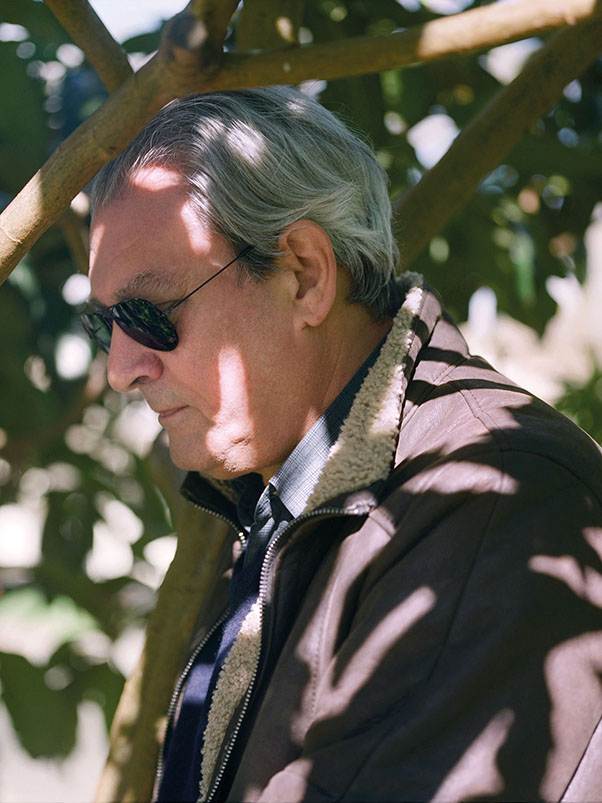
Paul Auster’s New York Trilogy (1987), his first published novel, remains one of those rare books whose initial, startling impact stays with me to this day. I read it as a callow grad student, four years late to the party, and swallowed it in one feverish sitting. I then promptly sought out his three subsequent novels published to that date, as well as his memoir of fatherhood, The Invention of Solitude. Until he died in 2024, Auster remained one of the few novelists who could send me to the bookstore on publication day.
In 1991, I’d been spending a lot of time with literary theorists – Walter Benjamin, Maurice Blanchot, Jacques Derrida – striving to decipher the paradoxes of their thinking around language, absence, difference and otherness. Auster, who quoted Blanchot in Invention, who seemed to be channelling early Benjamin’s theories of divine language in City of Glass, whose stories turn insistently around “the impossibility of possibility”, was being spoken of as the novelistic analogue to poststructuralism – seeing truth as radically elusive – which for detractors was simply proof of his writing’s hollow tricksiness. It seemed to me that for all his undoubted points of contact with the philosophes, there was something off about this designation of Auster as a “theory” novelist.
As his widow, Siri Hustvedt, writes in Ghost Stories, a memoir of her late husband, their marriage and her grief, the reduction of his books by many reviewers to “a bag of clever ‘postmodernist’ tricks overlooked the urgency, passion and thought in his novels”.
Auster’s writing is in no sense a translation of postmodernist theory into readable narrative form. He might evoke Blanchot or Derrida in his fascination for ghostliness, mourning and chance, and in his antennae for the essential strangeness of experience, but his aim is to render how these phenomena feel, to make it reverberate in the reader’s ears and guts rather than to conceptualise it. Auster’s later novels The Music of Chance, The Book of Illusions and 4 3 2 1 are unabashed page-turners because they dare us to imagine the ways life can spiral out of control, make itself suddenly and traumatically unrecognisable to whoever is living it. There is always a moment of sudden, strangely thrilling and unmistakably bodily awareness in reading his novels that we’re riding a swelling wave of dread.

Auster’s writing abounds with allusions to other writers, but these evocations are more poetic than discursive. In fact, as Hustvedt writes pointedly here, for all the critical perception of Auster as a cerebral writer, it was well established between the couple that, as Auster put it, “Siri was the intellectual in the family.”
Auster, she informs us, read predominantly in history and literature. Much of his knowledge of the history of ideas came via Hustvedt, whose own writings range across philosophy, psychiatry, psychoanalysis, the history of medicine, art history and theory, and feminist theory, as well as fiction and poetry. Themes from these disciplines and intellectual traditions are explored in a number of essay collections, and woven into both her earlier memoir The Shaking Woman and novels.
This memoir hints at how, in spite of their quite different personal and intellectual temperaments, the themes and motifs – ghosts, grief, memory, absence – of her writing so strikingly overlap with Auster’s. In one of many moving passages, she recalls an occasion on which she read her novel-in-progress to Auster, only to be told that a line in it appeared verbatim in one of his own. “Writing fiction,” she elaborates, “is like dreaming while awake”; the ultimate sources of the dream and of creative work are similarly obscure, attesting to the hazy borders between ourselves and those around us.
In paying homage to both the man and the marriage its author has lost, Ghost Stories becomes a vivid demonstration of this mutual imaginative permeability. It collages stories of their courtship, his illness and death, her grief, the daughter they raised together, the devastating double blow of his baby granddaughter Ruby’s death in 2021 followed six months later by the death of his son (Hustvedt’s stepson) Daniel, by drug overdose. These events are interlaced with a winning portrait of the everyday joys and irritations of their shared life, as well as a vivid depiction of the confusions and consolations of living without him, the mourning not only of the man but the sharedness in which she had made her life for so many years, or as Hustvedt has it, “That ‘and’ where he and I overlapped.”
The loss of this “and” shapes not just the themes but the very texture of the book. Ghost Stories is not merely about mourning but is itself an act of mourning, integrating into its structure the disjointed, recursive nature of the experience itself. It is an artfully broken book, shifting between memories of Auster as living presence and as ghost, between what they enjoyed together and shattering loss.
Auster, Hustvedt tells us, repeatedly expressed a wish “to come back as a ghost”. The book facilitates that return in recalling vivid sensations of his spectral presence – the smell of his cigar smoke, the feel of his leather jacket – after his death, but more palpably in the form of the five letters Auster wrote to his recently born grandson Miles during the last few weeks of his life.
The letters are poignantly coloured by Auster’s awareness of his impending death, meaning his grandson can only ever meet him personally through the ghostly mediation of these pages. It is some consolation that the fog of terrible pain and cancer medication fails to dim the clarity and warmth of Auster’s writerly voice. Even the final letter, revealing the loss of all hope of cure and the imminence of the end, manages to infuse the awful truth with affection and mordant wit, its penultimate lines identifying the American republic’s predicament with his own: “On life support, perhaps, but still breathing.”
Ghost Stories turns around the silences and gaps lurking inside all communication. Writing, especially when it concerns extremities of the inner life, is always pulled between the impulse to speak and the counter-impulse “to keep your mouth shut. It’s not always easy to determine which is right, either.” It is hard not to think here of the many Auster protagonists who, having undergone a kind of voiding of their own self, fall into a state of Bartleby-like withdrawal and silence.
The problem with speaking is that it tends to assume that whatever one seeks to convey can be made intelligible in language. Grief gives the lie to this assumption; its charge is so much in excess of any words that could contain it, revealing babbling and speechlessness as two sides of the same coin. Hustvedt quotes a line from Emily Dickinson’s correspondence: “Abyss has no biographer.” Rendering the experience of grief in words is like writing a diary, Hustvedt says, “and, like many diaries, probably all of them, it is full of holes – a geography of telling and not telling”.
This geography is linked to another prominent motif of Auster’s fiction, namely endlessness – the refusal of life to resolve itself in some tidy concluding synthesis. All any book can do is acknowledge that grief is an object too elusive to be bound by any book. As Hustvedt writes, “My grief won’t end but it will keep changing.” This wise, paradoxically vital account of her unending grief might just be the very form Auster would have wished his ghostly return to take.
Josh Cohen’s most recent book, All the Rage: Why Anger Drives the World, is published by Granta
Ghost Stories: A Memoir
Siri Hustvedt
Sceptre, 320pp, £22
Purchasing a book may earn the NS a commission from Bookshop.org, who support independent bookshops
[Further reading: The Marilyn Monroe we keep inventing]
Content from our partners



Related



This article appears in the 10 Jun 2026 issue of the New Statesman, How Britain lost control
Join the debate
Subscribe here to comment